

The next 12 months in marketing will feel like 5 years. Here’s your roadmap.
I’ve been in marketing for 22 years. I saw the golden age of SEO. I saw Facebook ads rise and... evolve. I watched “growth hacking” come and go.
But what I’m seeing now is different.
It’s not a new channel. It’s not a new tool.
The entire operating model is changing.
And those who don’t see it will either burn out or get pushed out by the end of 2026.
This isn’t pessimism. This is pattern recognition.
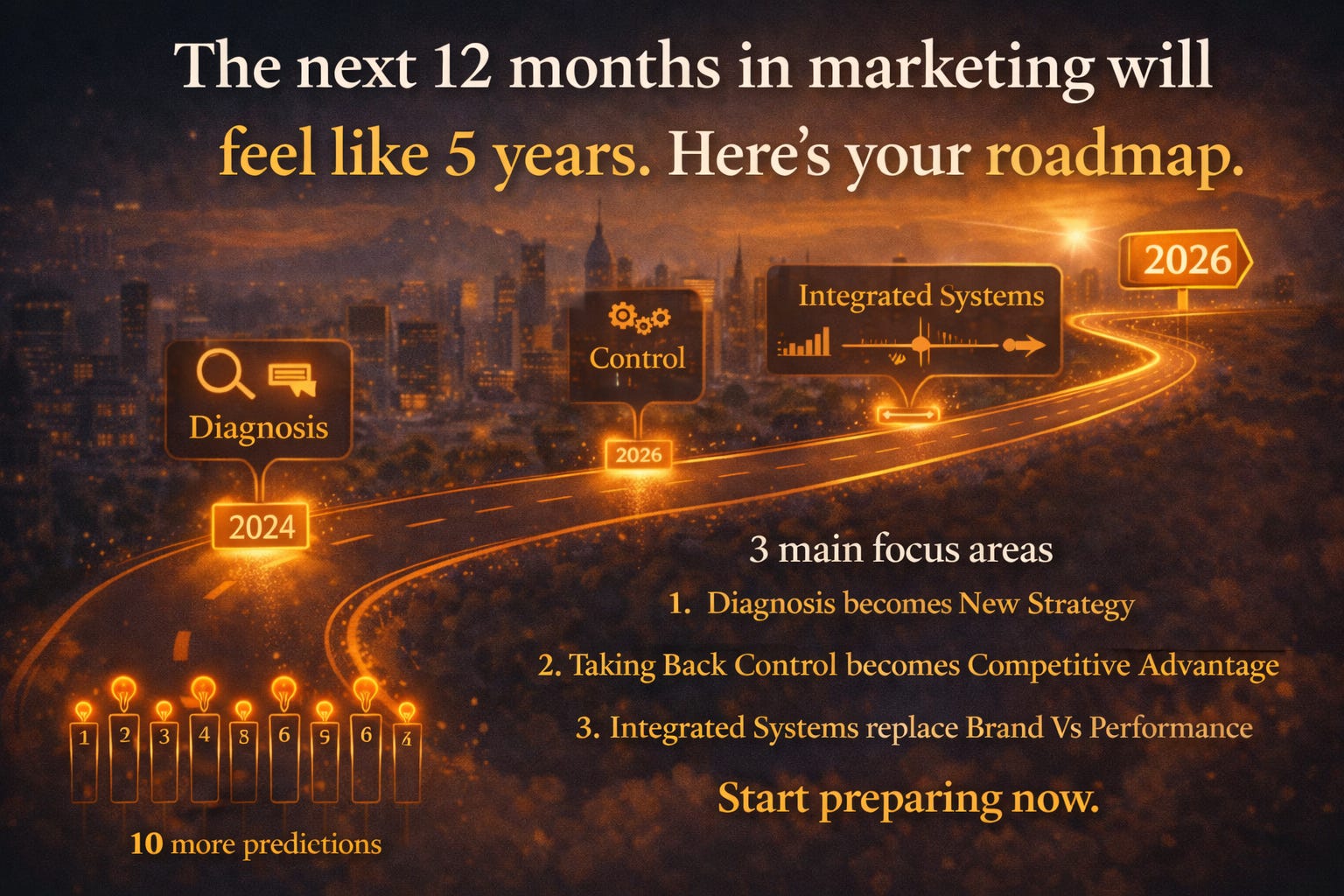
The Three Areas You Need to Focus on in 2026
1. Diagnosis Becomes the New Strategy
What’s happening:
AI is commoditizing execution.
30 articles per month? Automatable.
Creative variants? AI generates them.
Campaign optimization? Machines do it better.
What’s NOT being commoditized: understanding what the problem actually is.
The value of advice like “create more content” and “increase the budget” is dropping to zero. Anyone can produce more content. Anyone can increase spend.
The question is: “Why isn’t what we’re doing working?”
AI can’t answer this — because it doesn’t understand the context, the market, your company’s history, your customers’ real problems.
Prediction: By the end of 2026, demand for “marketing audits” will double. But most audits will still only look at surface metrics. Those who diagnose at the system level will win.
2. Taking Back Control Becomes the Competitive Advantage
What’s happening:
The marketing ecosystem is getting more complex:
More channels
More tools
More AI solutions
More “experts” telling you what to do
Meanwhile, marketing leaders feel more lost than ever.
I wrote recently about “machine trading with machine” — Google’s AI optimizes the ads, the consumer’s AI optimizes the decision. We sit at the dashboard watching numbers neither side generates for our benefit.
Taking back control doesn’t mean doing everything yourself.
It means understanding what’s happening and why.
Prediction: In 2026, there will be two types of companies:
Those who understand and control the system
Those who pay the system without understanding it
The first group will have 20-30% higher margins.
3. The “Brand vs Performance” Debate Finally Dies
What’s happening:
For decades, the debate has raged: brand building or performance marketing?
AI is showing this was a false dichotomy all along.
Performance marketing is getting more expensive (more competition, more AI-optimized campaigns, rising CPCs). A purely performance-based approach is becoming unsustainable.
Brand building alone isn’t enough — because you can’t measure it, and the CFO won’t fund the “it’ll pay off someday” strategy.
The solution: Think in systems. Brand and performance aren’t two separate things — they’re two sides of a single system.
Prediction: In 2026, the companies that win will build integrated measurement models. Not last-click, not first-touch. But: “What’s the total impact, and where’s the leverage point?”
10 More Predictions for 2026
The agency model continues to erode. Instead of big, full-service agencies, specialized diagnostic-focused partners emerge.
“Content is king” finally dies. Everyone has content. Strategic relevance becomes king.
Privacy-first marketing won’t be a compliance issue — it’ll be a competitive advantage. Those who collect data ethically will have better data.
Marketing-sales integration is no longer optional. Those still thinking in silos fall behind.
Short-form video either gets regulated or dominates everything. No middle ground.
The “Temu effect” spreads. Not just retail — price-disrupting entrants coming to every industry.
AI won’t replace marketers — it’ll replace bad marketers. Those who can’t work with AI get pushed out.
Marketing automation platforms consolidate. 2-3 major players remain, the rest merge or disappear.
Influencer marketing professionalizes. Fewer influencers, but deeper, longer-term partnerships.
“Growth at all costs” ends for good. Profitable growth becomes the only acceptable metric.
What Should You Do Now? 5 Concrete Steps
1. Audit Your System
Not your campaigns. Your system.
Where is growth getting stuck?
Which layer is blocking the others?
What’s the ONE thing that, if changed, would make everything else easier?
2. Define What You Will NOT Do in 2026
Write a list. Seriously.
“We will NOT do this in 2026, no matter what the agency/market/competition says.”
That list is your strategy.
3. Build Internal Diagnostic Capability
Don’t just outsource the thinking.
Have someone on the team who understands the full picture — not just their own silo.
4. Start Measuring, Not Just Reporting
Reporting: “What happened?”
Measuring: “Why did it happen, and what follows from it?”
Ask causal questions, don’t just look for correlations.
5. Take Back Control
The agency doesn’t tell you what to do.
AI doesn’t tell you what to do.
The competition doesn’t tell you what to do.
You decide. Then they execute.
The Choice in 2026
Two paths:
A. Continue in reactive mode. Follow trends. Do what “everyone does.” Hope it works.
B. Understand the system. Diagnose before you act. Know what you will NOT do. Be in control.
The difference isn’t about intelligence.
It’s about decision.
The question isn’t “What will happen in 2026?”
It’s: “Who will be running your marketing — you, or the marketing ecosystem?”
If you feel that 2026 will be different — and you want to be ready — reply to this. You’re not alone.
Laszlo