

Andrej Karpathy — former Director of AI at Tesla, one of the most respected minds in machine learning — posted this a month ago:
“I’ve never felt this much behind as a programmer. The profession is being dramatically refactored... I have a sense that I could be 10X more powerful if I just properly string together what has become available over the last ~year and a failure to claim the boost feels decidedly like a skill issue.”
He goes on to describe the “new programmable layer of abstraction” — agents, subagents, prompts, contexts, memory, modes, permissions, tools, plugins, skills, hooks, MCP, LSP, slash commands, workflows, IDE integrations...
And then this line:
“Clearly some powerful alien tool was handed around except it comes with no manual and everyone has to figure out how to hold it and operate it, while the resulting magnitude 9 earthquake is rocking the profession.”
1.7 million views. 17,000 likes. 921 comments.
This clearly resonated.
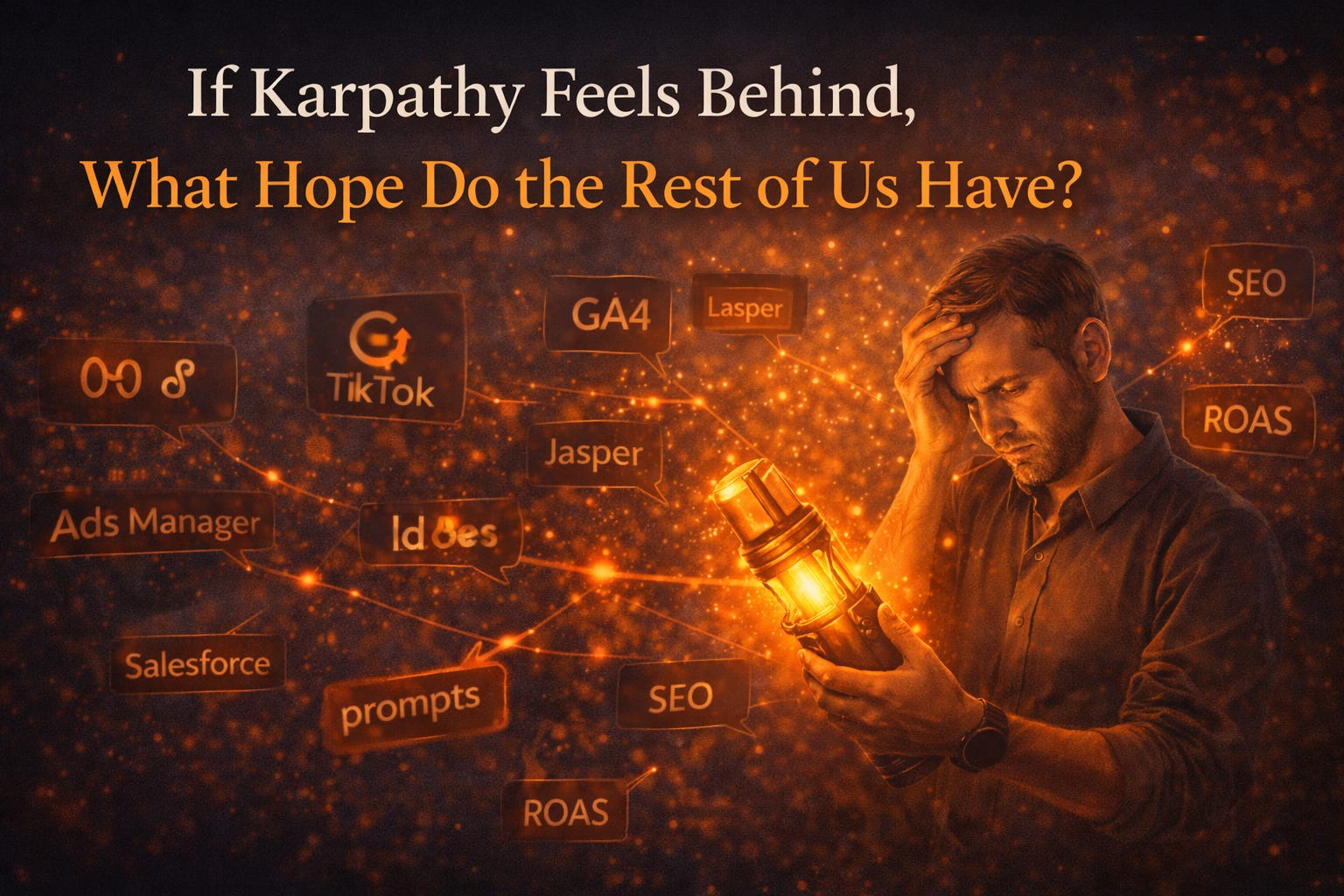
The Marketing Parallel
If Andrej Karpathy — someone who literally built AI systems — feels overwhelmed by the pace of change...
What does that mean for the rest of us?
For marketing leaders who aren’t AI engineers?
For founders who just want their business to grow?
For anyone trying to figure out which tools to use, which trends to follow, which “game-changer” to adopt this week?
The honest answer: we’re all holding an alien tool with no manual.
The Tempting Conclusion (And Why It’s Wrong)
The tempting conclusion from Karpathy’s post is: “I need to learn faster. I need to adopt more. I need to roll up my sleeves and not fall behind.”
And for programmers building with AI, that might be true.
But for marketing leaders, I think the conclusion is different.
Because marketing’s problem isn’t that we haven’t adopted enough tools.
It’s that we’ve adopted too many — without knowing which ones actually matter for our specific situation.
The Marketing Version of Karpathy’s List
Karpathy lists: agents, subagents, prompts, contexts, memory, modes, permissions, tools, plugins, skills, hooks, MCP, LSP, slash commands, workflows, IDE integrations...
Here’s the marketing version:
GA4, Meta Ads Manager, Google Ads, TikTok Ads, LinkedIn Campaign Manager, HubSpot, Salesforce, Klaviyo, Mailchimp, Semrush, Ahrefs, Hotjar, Amplitude, Mixpanel, Figma, Canva, ChatGPT, Claude, Jasper, Copy.ai, Midjourney, DALL-E, Zapier, Make, n8n, Notion, Monday, Asana, Slack, and whatever launched last Tuesday...
And that’s just the tools.
Add the strategies: SEO, PPC, Content Marketing, Social Media Marketing, Influencer Marketing, Email Marketing, Marketing Automation, ABM, PLG, Community-Led Growth, AI-Assisted Everything...
Add the metrics: ROAS, CAC, LTV, MRR, ARR, NRR, Churn, Retention, Engagement Rate, Click-Through Rate, Conversion Rate, Attribution...
Add the advice: what your agency says, what the conference speaker said, what that LinkedIn post said, what AI said when you asked it...
No wonder marketing leaders feel lost.
The Difference Between Programming and Marketing
Here’s where I think the parallel breaks down — in an important way.
For programmers, the answer probably is “learn more, faster.”
For marketing leaders, the answer is the opposite: learn less, but learn what actually matters for your situation.
Because in programming, you’re building systems. The more tools you can orchestrate, the more powerful you become.
In marketing, you’re making decisions. And more tools don’t make decisions easier — they make them harder.
Every new tool is another voice saying “use me.”
Every new strategy is another option to evaluate.
Every new metric is another number to track.
More inputs don’t create clarity. They create noise.
The Real Skill Issue
Karpathy says failure to claim the 10X boost “feels decidedly like a skill issue.”
In marketing, I’d frame it differently:
The skill issue isn’t failing to adopt new tools fast enough.
The skill issue is not knowing which layer of your marketing is actually blocked — and therefore not knowing which tools (if any) would actually help.
If your positioning is wrong, better ad creative won’t save you.
If your offer has no urgency, a new landing page builder won’t help.
If you’re targeting the wrong customer, more sophisticated targeting tools just help you reach the wrong people faster.
The skill isn’t tool adoption.
The skill is diagnosis.
What “Rolling Up Your Sleeves” Actually Means
Karpathy ends with: “Roll up your sleeves to not fall behind.”
I agree — but not in the way you might think.
For marketing leaders, rolling up your sleeves means:
1. Stop adding tools. Start understanding the ones you have.
You don’t need another platform. You need to know why the current ones aren’t working.
2. Stop following every trend. Start knowing which trends are relevant to YOUR situation.
Not every “game-changer” changes YOUR game.
3. Stop asking “What should we do?” Start asking “Where are we actually stuck?”
The answer to “what should we do” is infinite.
The answer to “where are we stuck” is specific.
4. Stop letting the ecosystem decide. Start deciding for yourself.
The tools want you to use tools.
The agencies want you to need agencies.
The platforms want you to stay on platforms.
None of them are optimized for you to be in control.
The Alien Tool With No Manual
Karpathy’s metaphor is perfect: “a powerful alien tool handed around with no manual.”
That’s exactly what marketing feels like right now.
But here’s the thing about alien tools with no manuals:
The solution isn’t to push random buttons faster.
The solution is to step back and understand what the tool is actually for — and whether it’s the right tool for your situation.
The manual isn’t coming.
The clarity has to come from you.
And that starts with seeing where you actually are — not where you think you are, or where someone told you to be.
The Question
Karpathy asks himself: “Could I be 10X more powerful if I properly strung together what’s available?”
The marketing version of that question is different:
“Could I be 10X more effective if I stopped stringing things together — and focused on the ONE thing that’s actually blocking me?”
The answer, almost always, is yes.
If you feel like you’re holding an alien tool with no manual — you’re not alone. The first step isn’t learning more. It’s seeing where you actually are.
Laszlo