

OpenAI announced plans to introduce advertising to ChatGPT at $60 CPM.
The internet did the math: that’s 2-4x more expensive than Meta ads in the US market.
“Who would pay that?”
“They’ve lost their minds.”
“This will never work.”
They’re all missing the point.
---
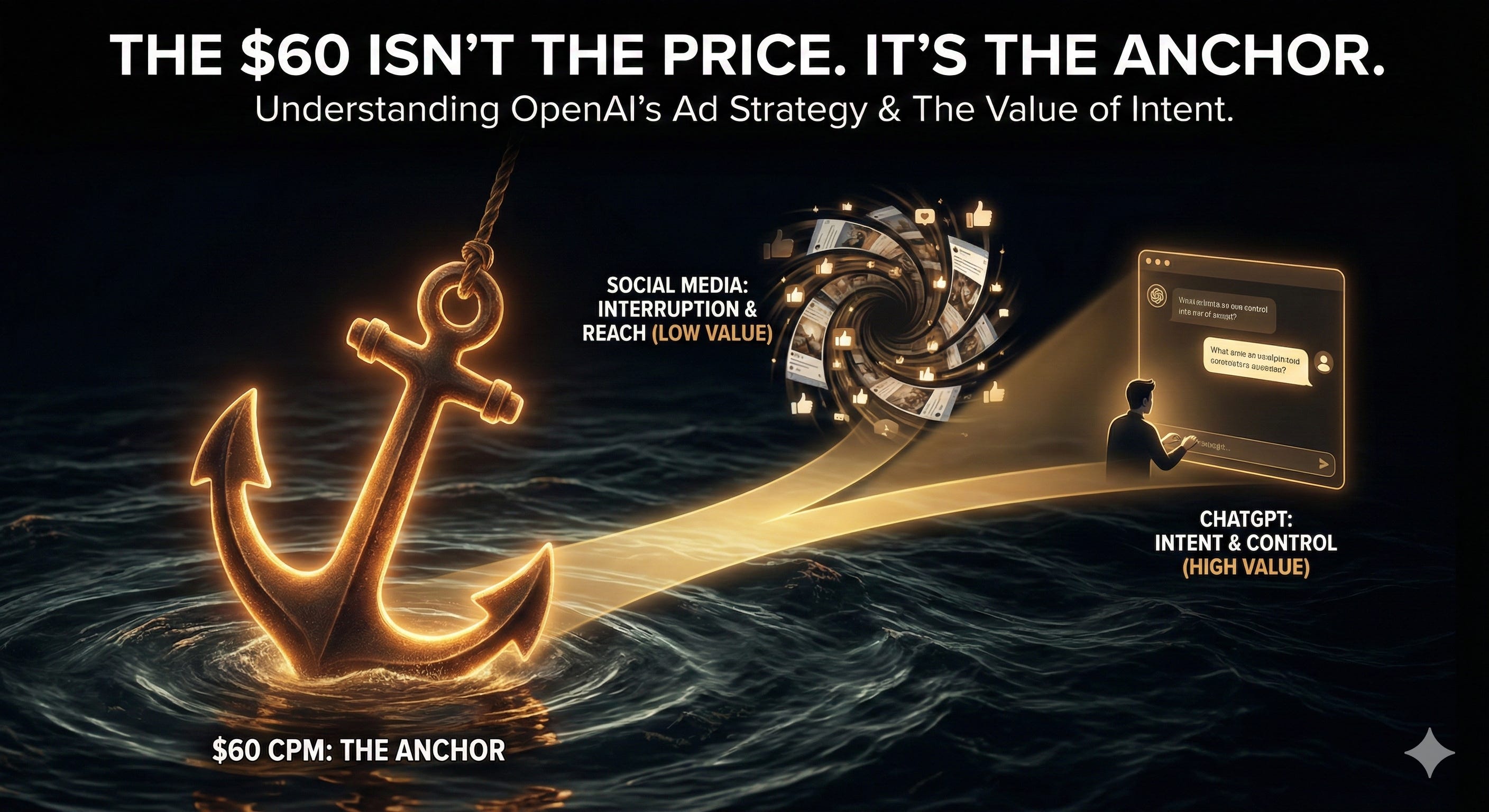
## The $60 Isn’t the Price. It’s the Anchor.
This is textbook pricing psychology.
You don’t launch at the price you want. You launch at the price that makes your real price look reasonable.
Watch what happens next:
- Industry outrage at $60
- OpenAI “listens to feedback”
- Launch at $40 CPM
- Everyone feels like they got a deal
The $60 was never the price. It was the setup.
---
## But Here’s What Actually Matters
Forget the price for a moment. Ask a different question:
**What kind of attention is OpenAI selling?**
On Meta, you’re buying interruption. Someone is scrolling through vacation photos, and you interrupt them with an ad. They didn’t ask for you. They’re not looking for solutions. They’re killing time.
On ChatGPT, you’re buying intent.
Someone actively typed a question. They have a problem. They want an answer. They’re not scrolling — they’re searching for something specific.
This is fundamentally different attention.
---
## The Intent Premium
Google built a trillion-dollar business on one insight: people who search for something are more valuable than people who are just browsing.
Search ads convert better than display ads. Not because search ads are prettier. Because the person already has intent.
ChatGPT users have intent on steroids:
- They’re not just searching — they’re asking
- They’re not scanning 10 results — they’re expecting one answer
- They’re engaged enough to type a full question, not just keywords
If OpenAI can capture that intent and deliver relevant ads without destroying the experience, $60 CPM might be cheap.
---
## The Real Risk
Here’s where it could go wrong:
**The UX destruction problem.**
ChatGPT’s value is the conversational experience. Clean. Focused. Helpful.
Ads break that.
If I ask “What’s the best project management tool for a 5-person team?” and the answer starts with a sponsored recommendation, I’ve lost trust. Not in the advertiser — in the platform.
OpenAI has to solve a problem Google never fully solved: how do you monetize intent without corrupting the answer?
If they get this wrong, the $60 CPM becomes worthless because users leave.
---
## The Marketer’s Question
So should you care about ChatGPT ads?
Here’s the framework:
**If your product solves a specific problem people ask about:**
- ChatGPT ads could be gold
- You’re buying qualified intent, not random eyeballs
- Even at $60 CPM, your cost-per-qualified-lead might be lower than Meta
**If your product is impulse-driven or awareness-focused:**
- This probably isn’t your channel
- You need interruption, not intent
- Stick with social feeds
**If you’re unsure:**
- Wait and watch the early data
- Let others pay for OpenAI’s learning curve
- The second-mover advantage is real when pricing is unstable
---
## The Bigger Picture
This isn’t just about OpenAI. It’s about a shift in how we think about advertising.
The social media era trained us to think about reach: how many people can I show this to?
The AI era will train us to think about intent: how qualified is the attention I’m buying?
Reach is cheap. Intent is expensive. And it should be.
The companies that understand this will pay $60 CPM happily — because they’ll make $200 back.
The companies that don’t will complain about the price while their competitors take the customers.
---
## The Bottom Line
Price is never high or low by itself.
It’s only high or low relative to the value it delivers.
OpenAI is betting that intent-based attention in a conversational context is worth a premium. They might be right.
The question isn’t “Is $60 too much?”
The question is: “What’s a qualified, intent-driven impression worth to my business?”
If you can’t answer that, the price doesn’t matter.
You’re not ready for this channel anyway.
---
*This is what I mean by CONTROL: understanding what you’re actually buying before you argue about the price. Layer 5 (Value) before Layer 4 (Offer). Always.*