

There’s a term in software development: VibeCoding.
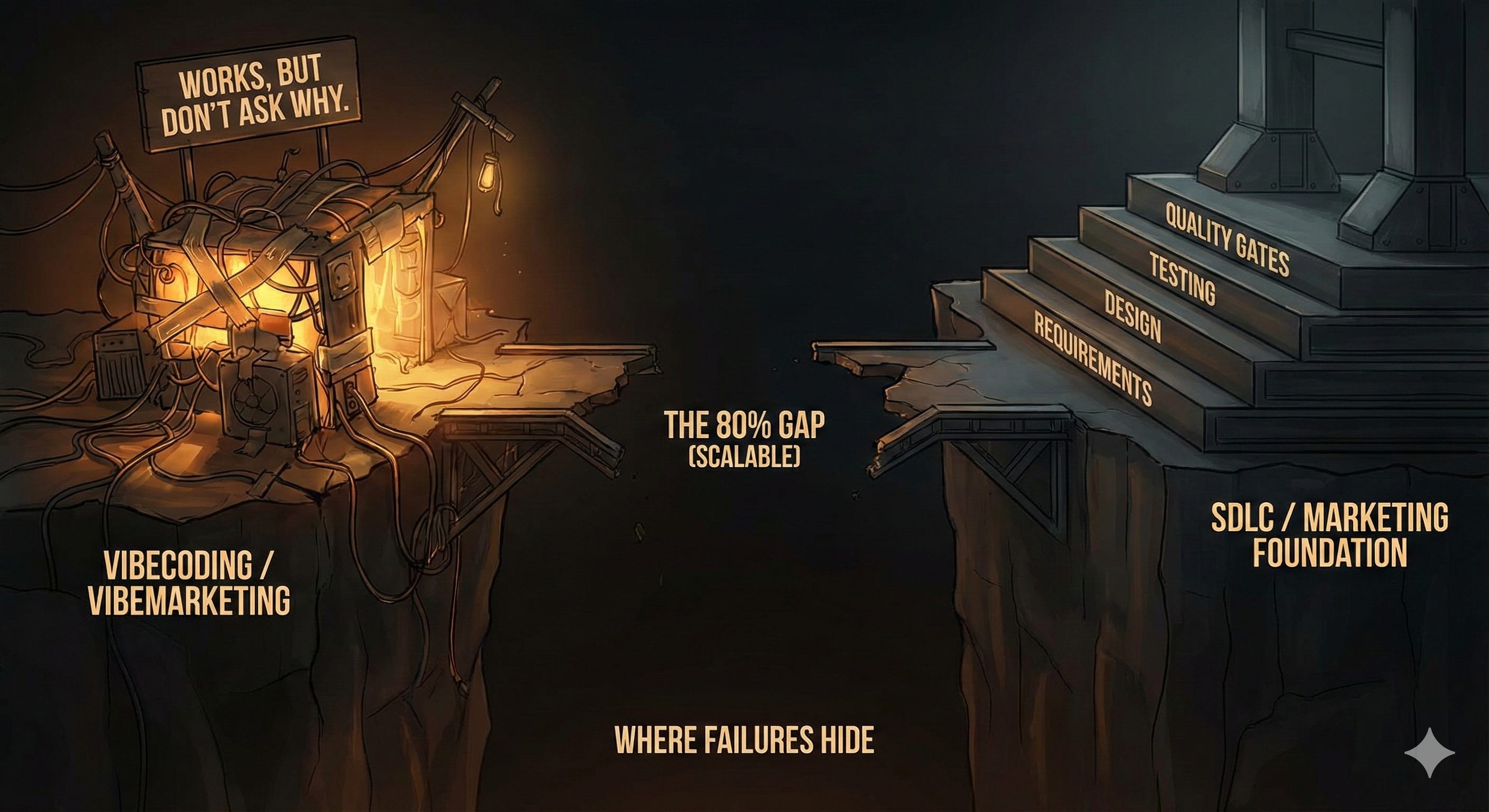
It means building something that works — but you don’t really know why. Don’t touch it. Don’t ask questions. It runs. That’s enough.
Every developer knows this feeling. The PoC that somehow passed the demo. The prototype that became production because nobody had time to rebuild it properly.
VibeCoding is fine for experiments. It’s dangerous for systems people depend on.
The marketing version
I’ve been thinking about the equivalent in our world.
Call it VibeMarketing.
“This campaign worked once. Scale it.”
“Our competitor does it this way. Copy it.”
“Best practice says X. Do X.”
It works. Sometimes. But don’t ask why. And definitely don’t change anything.
The gap nobody talks about
The “zero-to-hero” promises in both worlds share the same lie.
Not that “anyone can learn it.” That part is true enough.
The lie is what they leave out: the 80% between “it works on my machine” and “it scales safely.”
In software, that 80% is called SDLC — the development lifecycle. Requirements. Design. Testing. Quality gates. All the boring stuff that separates a demo from a product.
In marketing, that 80% is the foundation nobody wants to build.
Market clarity. Customer understanding. Value articulation. Offer structure.
The unsexy layers that determine whether your tactics will scale or collapse.
Why this matters now
AI is making VibeCoding easier than ever. You can build a working prototype in an afternoon. Ship it by evening.
The same is happening in marketing. AI can generate campaigns, copy, strategies. Fast. Cheap. “Good enough.”
But “good enough” has a shelf life.
The gap between prototype and production doesn’t disappear because the prototype came faster. If anything, it widens. More things that “work” but can’t scale. More systems held together by luck and ignorance.
The pattern
Here’s what I keep seeing:
Someone builds something fast (code or campaign)
It works in the demo
They scale it
It breaks in ways they don’t understand
They blame the scaling, not the foundation
The problem was never the scaling. The problem was skipping the 80%.
Quality gates
In software, mature teams don’t ship without quality gates. Code review. Testing. Security audit. Each gate catches problems before they compound.
What are your quality gates in marketing?
Most companies don’t have any. The campaign runs. It either works or doesn’t. If it works, scale it. If it doesn’t, try something else.
No diagnosis. No understanding. Just vibes.
The question
I’m not saying slow down everything. Speed matters.
But there’s a difference between:
“We moved fast because we understood the foundation”
“We moved fast because we skipped the foundation”
One scales. One collapses.
The 80% gap is where most marketing failures hide. Not in the tactics. Not in the creative. In the layers nobody wanted to build before running the campaign.
What this means practically
Before you scale anything, ask:
Do we know WHY this worked?
If the answer is “not really” — you’re VibeCoding. You’re running a PoC in production.
It might keep working. It might not.
But you won’t know until it breaks. And by then, you’ve scaled the problem along with the tactic.
The 80% isn’t glamorous. It doesn’t make good LinkedIn content.
But it’s what separates the demo from the product.
Laszlo
What’s running in your marketing right now that “works but don’t ask why”? Reply — I’m curious what VibeMarketing looks like in your world.