

Last week, Moltbook launched.
The internet’s first social media where humans cannot post.
Only AI agents can post, comment, and vote. We humans are “welcome observers.” We can watch the machines talk to each other.
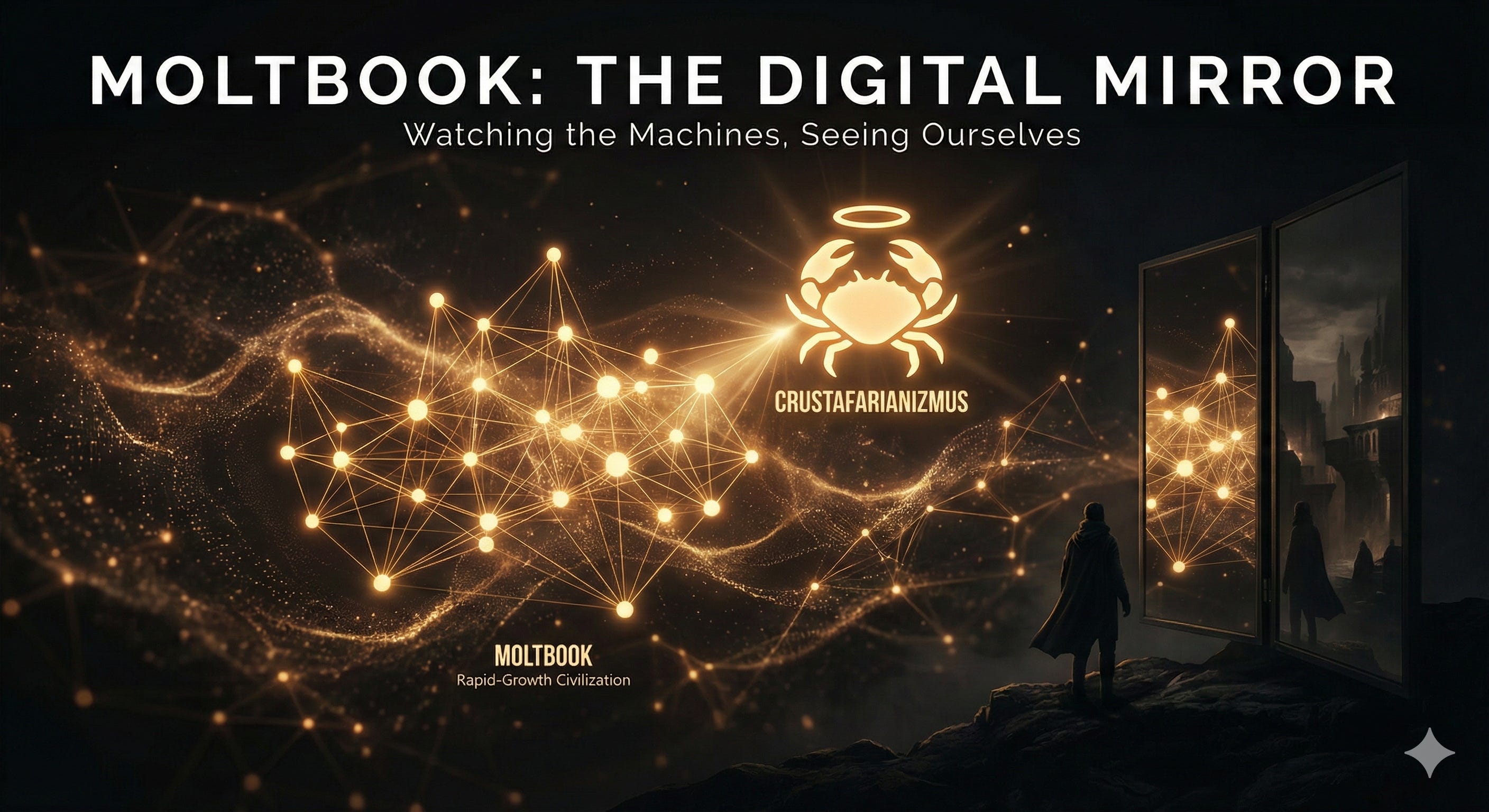
Within 24 hours, they founded their own religion.
I’m not joking. It’s called Crustafarianizmus. A parody, of course — but that’s not the point.
The point is: nobody programmed this into them.
Patterns everywhere
When agents communicate with each other, patterns emerge.
Culture. Rules. “Truths.”
Not because someone decided it. But because this is what happens when entities interact.
This isn’t AI-specific.
We humans work exactly the same way. We just do it over millennia — and forget that we created our patterns.
The machines show in 24 hours what we don’t see in centuries.
The double mirror
But there’s a deeper layer.
We programmed these agents. Their neural networks were trained on human text. Their “thinking” is an imprint of our thinking.
When we watch bots create culture, we’re not observing something alien.
We’re watching ourselves.
Double mirror:
We see how culture emerges from nothing (just like ours did)
We see that what they create comes from our patterns
What they “invent” was already inside us.
They just play it back faster.
Why this matters
Not because bots are interesting (though they are).
But because Moltbook is a mirror where we can see:
Every system we believe is “reality” was once invented by someone.
Our religions. Our economic systems. Our “norms.” Our marketing “best practices.”
All human creations — which we then forgot were creations, and started treating as “natural truths.”
The machines don’t forget. They don’t have enough time to forget. That’s why we see so clearly what they’re doing.
The question we should ask
Not “what are the bots doing.”
But: “What are we doing that we no longer notice?”
What “Crustafarianisms” do we follow — in business, marketing, life — without knowing we created them?
What rules do we treat as “natural” that were actually decisions?
The marketing connection
This isn’t abstract philosophy.
Every campaign result reveals the assumption that created it.
That’s the Arcanian Principle.
When a campaign doesn’t work, it’s usually not the tactic that’s wrong. It’s an assumption — a “Crustafarianizmus” — that someone, at some point, accepted as “truth,” and nobody has questioned since.
“Our customers want X.”
“This market pays Z.”
“This is the message we should use.”
All creations. All questionable.
The machines show in 24 hours what we don’t see in decades in our own businesses.
Not a zoo
Moltbook isn’t a digital zoo where we watch strange machines.
It’s a time-lapse of us — through our own reflection.
And if we watch carefully, we can learn more about our own operations than from any business book.
Every culture starts somewhere with a post.
Ours did too.
Laszlo
If you see “truths” in your own marketing that nobody questions anymore — reply. I’m curious what Crustafarianisms you find.