

Last week I talked to a marketing director.
Experienced, smart, 15 years in the game.
I asked: “What’s your plan for next quarter?”
She said:
“I don’t know yet. I’m waiting to hear what the agency says about the new Meta algorithm. And there’s a GA4 update coming. I should probably look at TikTok too, because everyone says we need to be there. And AI... I don’t even know where to start.”
15 years of experience.
And yet she’s not the one deciding what to focus on.
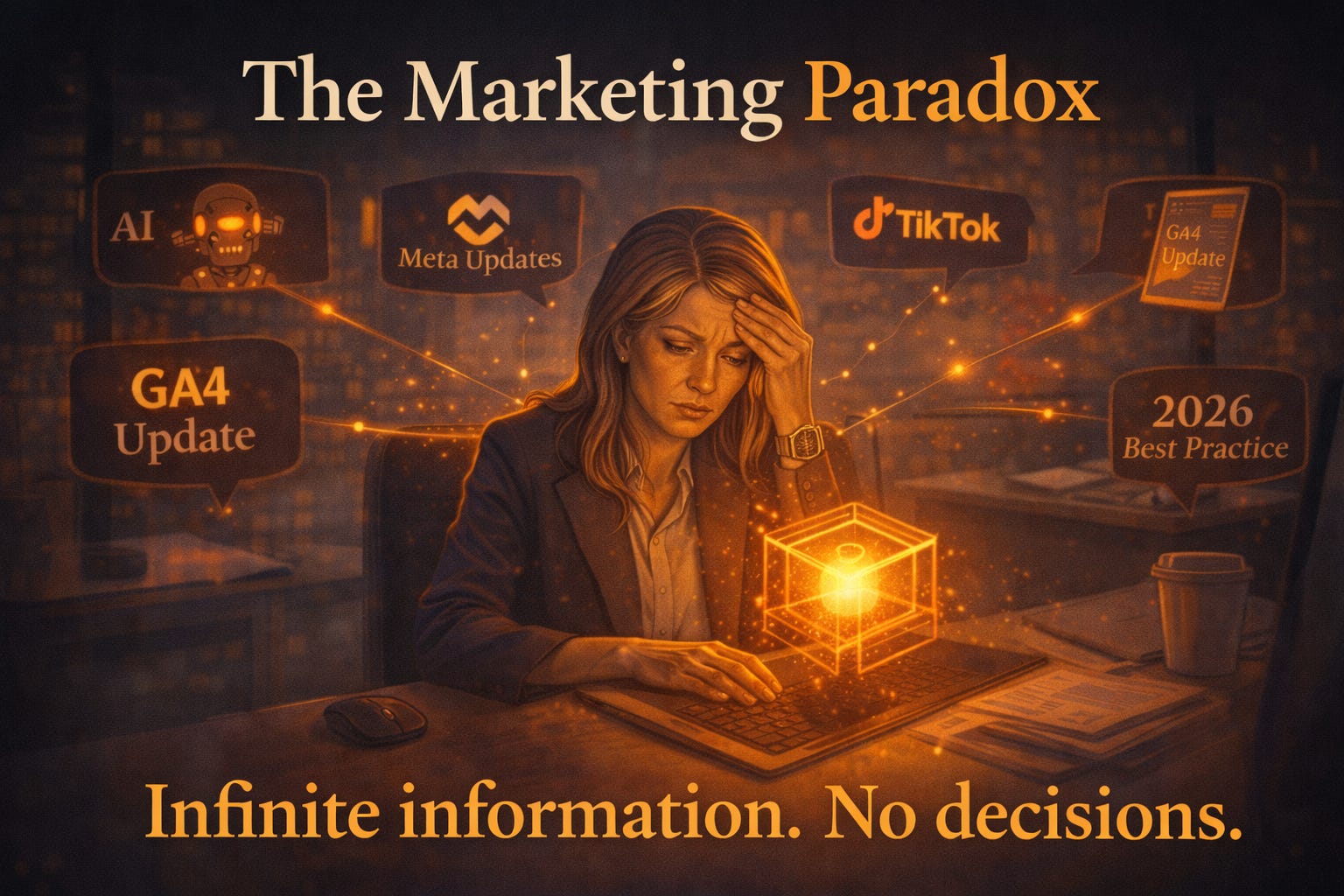
The Marketing Paradox
There have never been more tools, channels, possibilities.
And marketing leaders have never felt more lost.
Every week:
New algorithm update
New “game changer” tool
New advice from the agency
New best practice from the conference
New “you need to do this in 2026” article
Information is infinite.
Time is finite.
And the decision is always... “later.”
Why Does This Happen?
The marketing ecosystem isn’t optimized for you to be in control.
It’s optimized for you to be dependent.
The agency is optimized to make you need the agency
The tool is optimized to make you need the tool
The platform is optimized to keep you on the platform
No one has an interest in you seeing the full picture.
Because if you did, maybe you wouldn’t need the agency.
Maybe you wouldn’t need the new tool.
Maybe you’d do half of what you’re doing now.
The Symptoms of Lost Control
How do you know you’re not in control?
1. You’re reactive, not proactive
Your strategy: respond to what happens.
Not: decide what should happen.
2. You can’t say no
Every new channel, tool, opportunity “might be important.”
Because you don’t know what actually is important.
3. The agency tells you what to do
You don’t tell them what to focus on.
They tell you what to spend on.
4. You’re always “optimizing” but never moving forward
Better CTR. Better CPC. Better ROAS.
But the company isn’t growing.
5. You couldn’t explain your focus in one sentence
If someone asks: “What are you focused on right now?” — and the answer takes 5 minutes...
You’re not in control.
How Do You Take Back Control?
You don’t need more information.
You need less — but the right kind.
1. Understand where you are now
Not at the tools level. Not at the campaigns level.
But:
Who is your actual target audience? (Not “everyone”)
What’s the value you provide? (Not a feature list)
What’s your offer? (Not “our services”)
What makes you different? (Not “quality and reliability”)
If you don’t have clear answers to these, every tactic is just treating symptoms.
2. Decide what you will NOT do
Strategy isn’t about what you do.
It’s about what you give up.
If you want to be everywhere, you’ll be truly present nowhere.
Write a list: “We will NOT do this in 2026, no matter what the agency says.”
That list is your strategy.
3. The agency executes, it doesn’t strategize
The agency’s job: execute what you’ve decided.
Not: decide for you what’s important.
If the agency dictates the strategy, you’re not the client.
The agency is the client.
4. Ask: “What’s the ONE thing?”
Every week, every month:
“If I could only change ONE thing in marketing that would have the biggest impact — what is it?”
Not three. Not five. ONE.
If you don’t know the answer, that is the answer: “I don’t see it clearly enough yet.”
And then you don’t need to find the next tactic.
You need to find clarity.
Control Doesn’t Mean Knowing Everything
It means knowing what you know and what you don’t.
Knowing what’s important and what’s not.
You decide where the energy goes — not circumstances.
Marketing leaders who are in control aren’t smarter.
They don’t have more information.
They have less — but the right kind.
And they have a framework to place what they see into.
The Question Isn’t “What Should We Do in Marketing?”
The question is:
“Who decides what we do — us, or the marketing ecosystem?”
Next week: How to build a framework for your marketing decisions — so you don’t have to figure out what’s important every week.
If you feel like marketing is running you instead of the other way around — reply to this. You’re not alone.
Laszlo